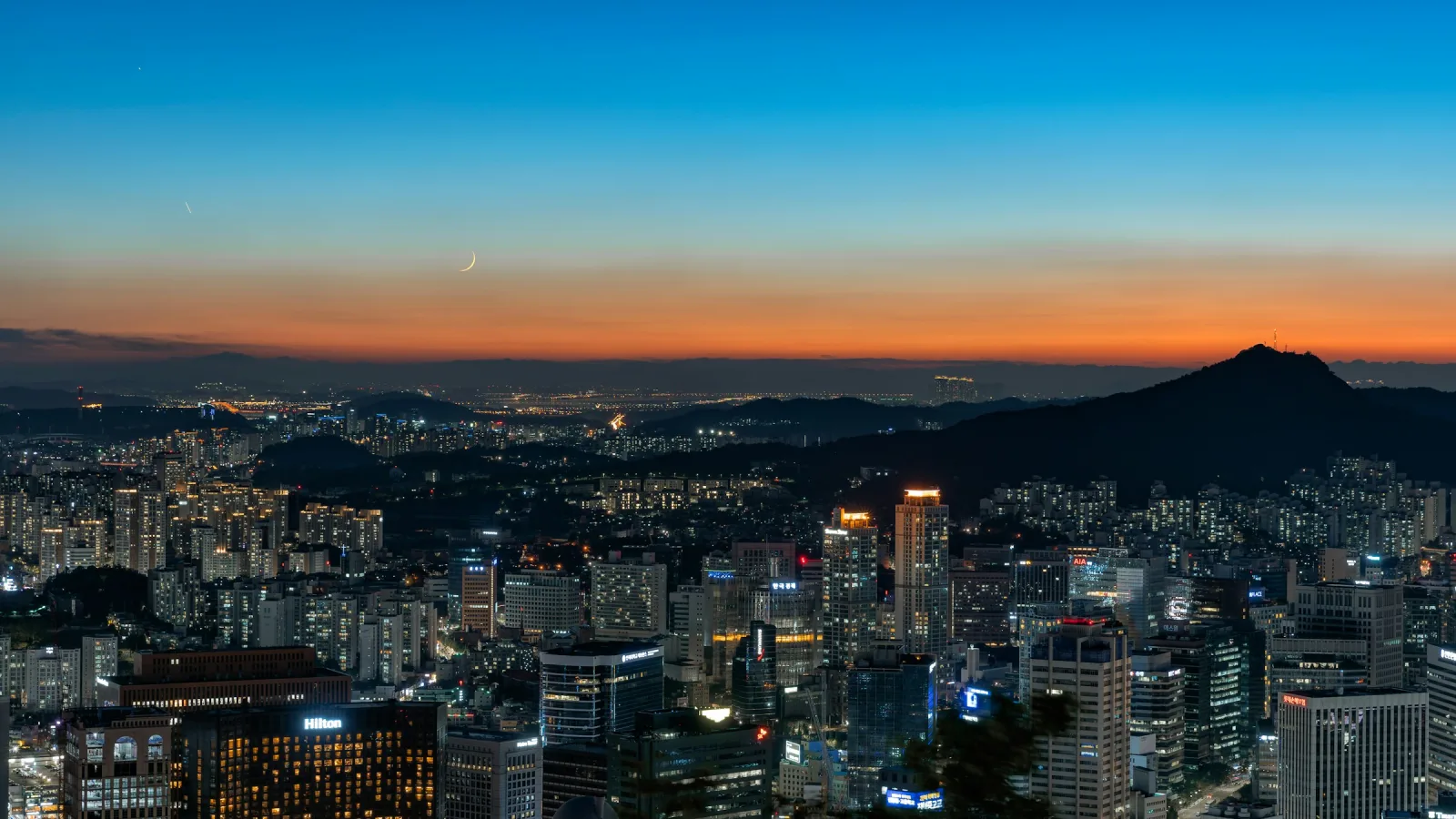
Sunset view over Gyeongbokgung Palace with traditional hanok roofs and modern Seoul skyline in the background, South Korea

South Korea Travel Guide
for Indian Travelers

Visa, cost, itinerary & tips — your complete guide to planning a trip to South Korea from India in 2026.

Updated for 2026 Travelers
Written by Nisha Chaudhary — Asia Travel Specialist
Reviewed by Namrata Sethi · Asia Travel Reviewer
Last updated after reviewing:
  • K-ETA waiver program extended for Indian travelers (April 2026)
  • Incheon Airport T1-T2 transit corridor security updates
  • Seoul Metro Line 9 extension & T-money card pricing revision 2026

Last updated: April 2026

South Korea Trip Cost from India (Detailed Breakdown)
Realistic cost breakdown for flights, K-ETA/visa, hotels, food, and total budget for 2026

Cost Breakdown 2026

  • Return Flights: ₹60,000 – ₹95,000 (direct)
  • K-ETA Fee: ~₹600 per person
  • Hotels (per night): ₹6,000 – ₹15,000
  • Food (per day): ₹2,000 – ₹4,500
  • Local Transport (per day): ₹800 – ₹1,500
  • Activities & Entry Fees: ₹8,000 – ₹18,000 total
  • Travel Insurance: ₹1,200 – ₹2,500
  • Total (8–10 days): ₹1.8L – ₹3.5L per person

South Korea is highly structured and budget-friendly on-ground. Seoul accommodation drives costs, but excellent public transit and affordable street food balance the daily spend.

Best Departure Cities

  • Delhi (DEL) — Direct flights to Incheon (ICN) daily on Air India & Korean Air
  • Mumbai (BOM) — Direct & one-stop options via Singapore or Bangkok
  • Bangalore (BLR) — Limited direct, usually connects via Delhi or Singapore
  • Hyderabad (HYD) — Good one-stop via Middle East or East Asia hubs
  • Chennai (MAA) — Connects via Singapore, Seoul, or Guangzhou

Delhi offers the most seamless direct routing to Seoul. Mumbai provides excellent competitive fares on regional carriers.

Ready to plan your South Korea trip? Let us handle K-ETA, flights, hotels, and guided tours.

View South Korea Tour Packages →
Flight Routes from India to South Korea
Flights from India to Incheon take 6–15 hours depending on layovers. Direct and premium routing options available.

Delhi to Incheon (ICN)

  • Direct: Air India AI 348 (DEL → ICN, ~6h 30m)
  • Direct: Korean Air KE 656 (DEL → ICN, ~6h 45m)
  • One-stop: DEL → Singapore → ICN (Singapore Airlines)
  • One-stop: DEL → Bangkok → ICN (Thai Airways / Korean Air)
  • Duration: 6.5 hours direct, 9–12 hours one-stop
  • Price Range: ₹60K – ₹90K (direct)

Mumbai to Incheon (ICN)

  • Direct: Air India AI 342 (BOM → ICN, ~7h)
  • One-stop: BOM → Dubai → ICN (Emirates + Korean Air)
  • One-stop: BOM → Doha → ICN (Qatar Airways)
  • One-stop: BOM → Seoul (via Incheon partners)
  • Duration: 7–8 hours direct, 10–14 hours via Middle East
  • Price Range: ₹65K – ₹1.1L

Note: Incheon (ICN) is a major Asian transit hub with excellent rail links to Seoul (AREX express: 43 mins). Check Asia travel guides for more regional information.

South Korea vs Japan Cost for Indian Travelers
How does South Korea compare to Japan on cost? Here is a practical comparison for Indian travelers.
Expense South Korea (8 days) Japan (8 days)
Flights₹60K – ₹95K₹55K – ₹90K
Visa₹600 (K-ETA)₹3,500 – ₹6,500 (e-Visa)
Hotels/night₹6K – ₹15K₹7K – ₹16K
Food/day₹2K – ₹4.5K₹3K – ₹6K
Local Transport₹800 – ₹1.5K/day (Metro/Bus)₹2K – ₹4K/day (JR/Shinkansen)
Total Trip₹1.8L – ₹3.2L₹2.2L – ₹3.8L
Flights
South Korea₹60K – ₹95K
Japan₹55K – ₹90K
Visa
South Korea₹600 (K-ETA)
Japan₹3.5K – ₹6.5K
Hotels/night
South Korea₹6K – ₹15K
Japan₹7K – ₹16K
Food/day
South Korea₹2K – ₹4.5K
Japan₹3K – ₹6K
Total Trip
South Korea₹1.8L – ₹3.2L
Japan₹2.2L – ₹3.8L

South Korea offers slightly better value on food and transit. The K-ETA simplifies entry and reduces upfront costs compared to Japan's visa process. Overall, Korea undercuts Japan by 15–20% on daily expenses.

Best Time to Visit South Korea from India
South Korea has four distinct seasons. Spring and autumn deliver ideal weather and cultural festivals.
Month Korea Season Seoul Jeju Island Busan India Travel Note
JanWinter ❄️Cold -6 to 4°C, dryChilly 2-8°CCool -1 to 6°CIndia holidays align with ski season & Naksan ice festivals
FebWinter ❄️Very cold, occasional snowCoastal windsCold, dryQuiet travel window, lower hotel rates
MarEarly SpringWarming 1-13°CCherry blossoms start lateMild 3-11°CPre-monsoon travel from India
AprSpring ✓✓Perfect 10-20°C, peak bloomsCanola fields bloomPleasant 8-16°CPeak cherry blossom season — book 3-4 months ahead
MaySpring ✓Warm 15-25°C, lush greenWarm, great for hikingComfortable 13-20°CIdeal for outdoor temples & palace tours
JunEarly SummerHumid 18-27°CWarm, occasional showersWarm, beach weather beginsPre-monsoon, fewer crowds
JulMonsoonHot, heavy rainHumid, typhoon riskRainy seasonAvoid coastal areas, indoor Seoul best
AugLate MonsoonHot & humid, festival monthWarm water, busyHazy, humidSummer vacation from India, book early
SepAutumn ✓Pleasant 17-26°CClear skies, hiking idealMild 16-24°CChuseok holiday — transport books out
OctAutumn ✓✓Perfect 10-21°C, foliageGolden autumn, crispCool, scenic coastBest month overall — book 4 months ahead
NovLate AutumnCool 3-14°C, dryChilly, quiet beachesCool 5-13°CShoulder season, great deals
DecWinter / LightsCold, Christmas marketsWinter winds, quietChilly 1-8°CIndia school holidays, festive Seoul lights
8-Day South Korea Itinerary for Indian Travelers
A balanced one-week itinerary covering Seoul culture, Jeju nature, and Busan coastal charm.

Day-by-Day Plan

  • Day 1: Arrive Incheon → AREX train to Seoul → Myeongdong check-in & dinner
  • Day 2: Gyeongbokgung Palace (rent hanbok) → Bukchon Hanok Village → Insadong
  • Day 3: Namsan Seoul Tower → Hongdae shopping & street food → K-pop museum
  • Day 4: Fly Seoul → Jeju → Seongsan Ilchulbong → Udo Island boat tour
  • Day 5: Hallasan National Park → Jeju Folk Village Museum → Coastal road trip
  • Day 6: Bus transfer Busan → Gamcheon Culture Village → Haeundae Beach
  • Day 7: Jagalchi Fish Market → BIFF Square → Templestay or spa day
  • Day 8: Return to Seoul → Airport express → Departure

Planning Notes

  • Transit: Buy T-money card at ICN arrival for seamless metro & bus travel
  • Budget option: Skip Jeju if tight — Seoul + Busan is a complete 6-day loop
  • Currency: Cards widely accepted, but keep ₩200K–₩500K cash for street markets
  • Language: Google Translate works excellently. Young Koreans speak basic English
  • Connectivity: Rent pocket Wi-Fi at ICN or buy local eSIM on arrival
  • Vegetarians: Look for "Chaeksik" restaurants. Inform guides in advance for group meals
  • Book ahead: April cherry blossom & October foliage peak — secure hotels 3-4 months early

Want a hassle-free South Korea trip? Our packages include K-ETA assistance, direct flights, 4-star hotels, and K-culture tours.

Book South Korea Tour Package →
South Korea Visa for Indians — Complete Guide & Travel Essentials
Essential information for Indian travelers — from K-ETA eligibility and time zones to plug adapters and transit apps.

Tip: Carry a T-money transit card and keep ₩100,000 in cash for traditional markets & small vendors.

South Korea Visa for Indians — 2026 Update

Update (April 2026): K-ETA waiver program extended for Indian nationals holding valid US, UK, Canada, Australia, NZ, or EU Schengen visas until April 2027. Source: Official K-ETA Portal.

  • With valid US/UK/CA/AU/NZ/EU visa: Apply online for K-ETA (₩10,000 fee). Enter visa-free for up to 30 days
  • Without foreign visa: Apply for regular C-3 tourist visa through Korean Embassy/Consulate
  • Where to apply: Embassy of South Korea in New Delhi, Consulate in Mumbai
  • Documents: Passport (6+ months), application form, photos, flight/hotel proof, bank statements, travel insurance
  • Processing time: K-ETA: 24–72 hrs | Regular visa: 5–10 working days
  • Duration permitted: K-ETA: 30 days | Tourist visa: up to 90 days
  • Note: K-ETA approval must be obtained BEFORE boarding flight. Airlines check it at check-in
CLICK TO KNOW MORE ABOUT VISA DOCUMENTATION & FEES

Time Zone

South Korea follows Korea Standard Time (KST), which is UTC+9 and 3.5 hours ahead of Indian Standard Time (IST). No daylight saving time observed.

  • Korea Standard Time (KST): UTC+9
  • South Korea is 3.5 hours ahead of Indian Standard Time (IST)
  • When it is 12:00 PM in Delhi, it is 3:30 PM in Seoul
  • No daylight saving time in South Korea
  • Business hours typically run from 9 AM to 6 PM KST
  • Banks operate 9 AM – 4 PM weekdays
  • Shopping malls open 10:30 AM – 10 PM, many 7 days/week
  • Restaurants serve lunch 11 AM–2 PM, dinner 5 PM–10 PM

Country Code

To call South Korea from India, use the international dialing code +82 followed by area code (without leading 0) and number.

  • International Dialing Code: +82
  • To call South Korea from India: 00-82-XX-XXXX-XXXX
  • Seoul area code: 2
  • Busan area code: 51
  • Jeju area code: 64
  • Emergency services: 112 (Police), 119 (Fire/Ambulance)
  • Major telecom: SK Telecom, KT, LG U+
  • Tourist SIM/eSIM available at ICN T1 & T2 arrivals
  • Free public Wi-Fi extensively available in Seoul metro areas

Socket & Plugs

South Korea uses Type C (European 2-pin) and Type F (Schuko 2-pin round) outlets at 220V, 60Hz. Plug compatibility is straightforward.

  • Type C and Type F — 220V, 60Hz
  • Type C (European 2-pin round) and Type F (Schuko) standard
  • Standard voltage is 220V with a frequency of 60Hz
  • Indian Type C plugs (2-pin round) work directly without adapter ✅
  • Indian Type D (3-pin round) plugs require a universal adapter
  • Universal travel adapters widely sold at ICN Airport & convenience stores
  • Most hotels provide adapters on request
  • Modern laptops/phones support 220V/60Hz natively

Indian Embassy in South Korea

The Embassy of India in Seoul provides consular services for Indian nationals traveling or residing in Korea.

  • Address: 47-2, Hannam-daero 4-gil, Yongsan-gu, Seoul 04387
  • Contact: +82 2 795 8000 / 8001
  • Email: [email protected]
  • Emergency (24/7): +82 10 9958 6208
  • Working Hours: Mon–Fri, 9:00 AM – 5:30 PM
  • Services: passport renewal, OCI, consular assistance
  • Register with MADAD portal before travel for advisories

South Korean Embassy in India

The Embassy of South Korea in New Delhi and Consulate in Mumbai handle visa, consular, and trade matters for Indian citizens.

  • Embassy New Delhi: 2, Tyagaraj Marg, New Delhi 110011
  • Contact Delhi: +91 11 4965 6000
  • Consulate Mumbai: 1004, Maker Chambers VI, Nariman Point
  • Contact Mumbai: +91 22 2285 7337 / 7338
  • Visa Section Email: [email protected]
  • Note: Apply via authorized visa centers (VFS/authorized agencies) for smoother processing
  • K-ETA: Apply exclusively online at k-eta.go.kr
  • Working Hours: Mon–Fri, 9:00 AM – 5:30 PM

Car Driving Orientation

Right-Hand Drive (Same as India)

  • South Korea drives on the right, same as India
  • International Driving Permit (IDP) required with valid home license
  • Speed limits: 30–50 km/h urban, 80–120 km/h expressways
  • Seat belts mandatory, strict enforcement
  • Zero tolerance for alcohol (0.03% BAC limit)
  • Car rental available, but excellent public transit recommended
  • GPS navigation (Naver Maps/KakaoMap) essential; Google Maps limited in Korea

App Based Taxi

Kakao T & Tada are Primary Ride-Hailing Apps

  • Kakao T dominates ride-hailing — integrates taxi, regular, and premium options
  • Tada offers mid-size van rides for families (requires Korean number or app setup)
  • Payment via international cards accepted on Kakao T
  • Average ICN → Seoul taxi: ₩50,000–₩80,000 depending on time/destination
  • Regular metered taxis (Silver/Black/Mobil) readily available
  • Subway & AREX express are faster & cheaper for airport transit
  • Public buses (T-money enabled) cover extensive urban & regional routes

Need help with South Korea K-ETA or visa? Our team assists with documentation and approval tracking.

South Korea Visa Assistance →
South Korea Culture, Language & Local Customs
Understand Korean etiquette, honorifics, and cultural norms to navigate local interactions smoothly.

Official Language

Korean (Hangul) — Official Language

  • Hangul is scientifically designed alphabet; highly logical to read once basics learned
  • Honorifics & age hierarchy deeply embedded in grammar and social interaction
  • English spoken widely in Seoul tourist zones, hotels, and younger demographics
  • Signage bilingual in major cities and transit systems
  • Learning basic greetings (Annyeonghaseyo, Gamsahamnida) highly appreciated
  • Translation apps (Papago > Google Translate) work best for Korean
  • Public announcements in metro/airports include English
  • Papago app recommended for offline menu/transport translation

Local Vocabulary

Knowing these essential Korean phrases helps navigate transit, dining, and polite interactions.

  • Annyeonghaseyo (안녕하세요) — Hello
  • Gamsahamnida (감사합니다) — Thank you
  • Eolma-eyo? (얼마예요?) — How much is it?
  • Mianhamnida (미안합니다) — Sorry/Excuse me
  • Hwajangsil eodi-yo? (화장실 어디요?) — Where is the restroom?
  • Kkae (깨) — Sesame
  • Kimchi (김치) — Fermented cabbage
  • Soju (소주) — Clear distilled liquor
  • Daebak (대박) — Awesome/Amazing
  • Chaeksik (채식) — Vegetarian meal
  • PPalli (빨리) — Quickly (Korean cultural efficiency trait)

Toilet Signs

Public restrooms are marked "Hwajangsil" (화장실). Modern Korean facilities are exceptionally clean and high-tech.

  • Men: "Namja Hwajangsil" (남자 화장실) | Women: "Yeoja Hwajangsil" (여자 화장실)
  • Highly maintained in metros, palaces, shopping districts, and highway rest stops
  • Many feature bidet seats, warm water, and automatic flushing
  • Free in public areas; some traditional markets may charge small fee (₩500)
  • Western seated toilets standard; squat toilets increasingly rare outside older areas
  • Carry tissue packets for older street-side facilities
  • Fully accessible/family restrooms available in modern buildings

Interesting Facts

South Korea leads global internet speeds, K-pop exports, and semiconductor innovation. It transformed from post-war nation to top-10 economy in decades.

  • Highest smartphone penetration globally; near-zero paper currency usage
  • Born in 2025 or 2024 makes you "1-3 years old" in Korean age system
  • Seoul has 5 UNESCO World Heritage palaces; all accessible via Line 3
  • Korea invented movable metal type (1234) before Gutenberg
  • T-money cards used for transit, vending machines, convenience stores, and small vendors
  • Birthdays celebrated with seaweed soup (Miyeok-guk), not cakes traditionally
  • Naver dominates search, Kakao dominates messaging, Coupang dominates delivery
South Korea Shopping & Markets Guide
From K-beauty and tech to traditional hanbok rentals and night markets.

Shopping Hours

Most Shops: 10:00 AM – 9:30 PM (Weekdays)

  • Lotte Mall, Shinsegae, Hyundai Department Stores operate 10:30 AM – 10 PM, 7 days
  • Traditional markets (Myeongdong, Namdaemun) open 9 AM – 6 PM; street food stalls till midnight
  • Duty-free at ICN opens 5 AM – 10 PM
  • Small boutiques & hanbok shops often open 10 AM – 8 PM, closed 1-2 PM for lunch occasionally
  • Tax refund counters available in major malls & ICN for purchases over ₩30,000
  • Best sale periods: June–August & December–January

Famous Markets

Seoul's traditional markets blend street food, crafts, textiles, and local culture in vibrant atmospheres.

  • Namdaemun Market — Largest traditional market, wholesale & retail, open till late
  • Gwangjang Market — Famous street food, mung bean pancakes, Mayak gimbap
  • Dongdaemun Market — Fashion wholesale & night shopping (open till 5 AM)
  • Myeongdong Street — K-beauty, souvenirs, international brands
  • Insadong Street — Hanbok, calligraphy sets, traditional crafts, tea houses
  • Cash preferred at traditional stalls; cards widely accepted in main buildings
  • Bargaining expected at markets, fixed pricing in department stores

Famous Brands

Korea leads global beauty, tech, and fashion trends. Local brands offer exceptional quality at mid-range prices.

  • K-Beauty: Innisfree, Etude House, Missha, Laneige, Sulwhasoo
  • Fashion: Musinsa, 8seconds, Gentle Monster (eyewear), Marithé
  • Tech: Samsung, LG, Hyundai
  • Snacks: Choco Pie, Honey Butter Chips, Pepero, Shin Ramyun
  • Traditional: Hanbok rentals, Korean ginseng, ceramic ware
  • Duty Free: Lotte, Shinsegae, Shilla — best for cosmetics & liquor

Convenience Stores

CU, GS25, and 7-Eleven operate 24/7, acting as micro-supermarkets, ATMs, and transit card top-up points.

  • GS25, CU, 7-Eleven — ubiquitous, open 24 hours, accept international cards
  • Sell heated bento meals, coffee (₩1,500), snacks, basic toiletries
  • Top up T-money cards at any store register
  • ATMs available inside most stores (Korean & English menus)
  • Parcel forwarding & ticket vending integrated
  • Clean, safe, well-stocked even at 2 AM in residential zones
South Korea Food & Cuisine Guide
Korean cuisine balances fermented flavors, grilled meats, rice staples, and innovative street food culture.

Do: Try Korean BBQ, street food at Gwangjang, and temple cuisine for vegetarian options.

Famous Cuisines

Korean food centers on rice, fermented vegetables, soups, and grilled proteins with shared side dishes (banchan).

  • Bibimbap — Mixed rice bowl with vegetables, gochujang, egg
  • Bulgogi — Marinated beef, sweet-savory, grilled
  • Korean BBQ (Samgyeopsal) — Pork belly grilled tableside
  • Japchae — Glass noodles, vegetables, sesame oil stir-fry
  • Tteokbokki — Spicy chewy rice cakes (street food staple)
  • Kimchi Jjigae — Spicy fermented vegetable stew
  • Sundubu Jjigae — Soft tofu stew with seafood/veg
  • Kimbap — Seaweed rice rolls (lunchbox staple)
  • Banchan — Free side dishes refilled with meals

Famous Fruits

Korean fruit markets (Gwail) emphasize premium quality, gift-box packaging, and seasonal exclusivity.

  • Korean Melon (Chamoe) — Sweet, crisp, yellow-striped, summer favorite
  • Persimmon (Gam) — Autumn fruit, eaten fresh or dried (Gotgam)
  • Strawberries — Winter-spring peak, large & sweet, exported globally
  • Peach (Boksung) — Summer, Gyeongju region famous
  • Korean Pears (Baе) — Large, juicy, autumn harvest
  • Tangerines (Hallabong) — Jeju specialty, sweet & tangy

National Dish — Kimchi & Bibimbap

Kimchi represents Korean culinary identity — fermentation, preservation, and flavor balance perfected over centuries.

  • Kimchi served with nearly every meal; 100+ regional varieties
  • Bibimbap represents harmony — vegetables, protein, rice, sauce in one bowl
  • Gochujang (fermented chili paste) & Ganjang (soy sauce) foundational flavors
  • Temple cuisine offers refined vegan/vegetarian interpretations
  • Street food alleys in Myeongdong, Hongdae, Gwangjang offer casual tasting
  • Korean fine dining (Michelin-starred in Seoul) elevates traditional flavors
  • Tipping not customary; service charge included

Avg Cost Of Food

Budget travelers eat well for ₩15,000–₩30,000 daily at local eateries. Mid-range dining ₩30,000–₩60,000 per meal.

  • Street Food/Market: ₩3,000 – ₩8,000 per item
  • Café/Bread: ₩3,500 – ₩6,000
  • Set Meal (Baekban): ₩7,000 – ₩12,000
  • KBBQ / Grill House: ₩20,000 – ₩40,000 per person
  • Mid-range Restaurant: ₩15,000 – ₩25,000
  • Fine Dining: ₩80,000 – ₩150,000+ tasting menus
  • Coffee (Americano): ₩1,500 – ₩5,000
  • Soju/Beer: ₩3,500 – ₩6,000

Tipping: Not expected in Korea. Water, ice, side dishes free at restaurants.

South Korea Weather & Packing Tips
Korea has four distinct seasons. Pack strategically for Seoul humidity, Jeju coastal winds, and Busan coastal chill.

Tip: Layering essential — Korean indoor heating is strong in winter; outdoor chill is sharp.

Weather

South Korea has four clear seasons with monsoon summer and cold dry winter.

  • Seoul: Hot humid summers (Jun–Aug, 25–33°C), cold dry winters (Dec–Feb, -7 to 5°C)
  • Jeju: Subtropical, milder winters (5–12°C), warm summers (24–30°C), frequent rain
  • Busan: Coastal, humid summer, mild winter (0–9°C), typhoon risk Aug–Sep
  • Spring (Apr–May): 10–23°C, cherry blossoms, ideal hiking & palace tours
  • Autumn (Sep–Nov): 10–22°C, clear skies, fall foliage peak
  • Monsoon (Late Jun–Jul): Heavy rain, carry compact umbrella & waterproof shoes
  • Winter: Dry, crisp, indoor heating strong, snow in Seoul mountains
  • Best overall: April, May, September, October

Clothes To Wear

Koreans dress smart-casual; avoid overly sporty clothes in palaces or fine dining. Pack layers for rapid indoor/outdoor temperature shifts.

For Seoul & Cities:

  • Light breathable fabrics summer (cotton, linen, UV protection)
  • Light jackets & sweaters for spring/autumn
  • Thick coat, thermal layers, scarves, gloves for winter
  • Comfortable walking shoes (palace complexes require extensive walking)
  • Compact umbrella (summer monsoon) or foldable windproof (spring)

For Jeju & Coastal:

  • Waterproof hiking shoes for Hallasan trails
  • Windbreaker for coastal walks
  • Light layers for sudden temperature shifts
  • Sunglasses & sunscreen (UV strong year-round)
South Korea Heritage & Cultural Highlights
UNESCO sites, temple stays, hanbok rentals, and cultural experiences that define Korea's identity.

UNESCO World Heritage Sites

Korea has 15 UNESCO World Heritage Sites, spanning palaces, temples, mountain shrines, and ancient printing archives.

  • Changdeokgung Palace Complex (1997) — UNESCO-listed, harmony of architecture & nature
  • Seokguram Grotto & Bulguksa Temple (1995) — Silla-era Buddhist masterpieces
  • Hwaseong Fortress (1997) — Suwon, Joseon military architecture
  • Jongmyo Shrine (1995) — Royal ancestral shrine, Confucian rites
  • Jeju Volcanic Island & Lava Tubes (2007) — Natural heritage, Manjanggul caves
  • Seowon Confucian Academies (2019) — 9 historic academies across Korea

National Symbols

Korea's national identity blends Joseon dynasty heritage, Confucian ethics, and modern technological advancement.

  • National Flag: Taegukgi (Yin-Yang & four trigrams)
  • National Flower: Mugunghwa (Rose of Sharon) — resilience & eternity
  • National Tree: Pine — longevity & evergreen strength
  • National Animal: Siberian Tiger (mythical guardian)
  • National Bird: Red-crowned Crane — peace & longevity
  • National Sport: Taekwondo (UNESCO Intangible Heritage)
  • National Dish: Kimchi & Bibimbap

Traditional Experiences

Seoul and regional heritage centers offer immersive cultural programs blending history with hands-on learning.

  • Templestay — Overnight Buddhist meditation & monastic life experience
  • Hanbok Rental — Traditional dress wear for palace entry (free admission if wearing hanbok)
  • Tea Ceremony — Traditional Korean tea (Darye) in Insadong or Bukchon
  • Kimchi Making — Hands-on fermentation workshop at cultural centers
  • Calligraphy & Hanji — Traditional paper crafting & brush painting
  • Martial Arts — Taekwondo introductory classes in Seoul dojangs

Souvenirs

Best places: Insadong, Myeongdong duty-free, Lotte Mart, airport duty-free counters.

  • K-Beauty Sets — Sheet masks, toners, sunscreen (buy 5 get 3 deals common)
  • Hanbok Miniatures — Decorative figures & bookmarks
  • Soju & Makgeolli — Korean liquor (check duty-free allowance)
  • Seaweed & Ramen — Premium brands & limited editions
  • K-Pop Merch — Albums, lightsticks, photocards
  • Traditional Tea & Ceramics — Insadong tea houses & pottery studios
Notable Highlights for Indian Travelers
From K-Wave dominance to tech innovation, discover what makes South Korea a global cultural powerhouse.

Famous People

  • BTS — Global K-pop ambassadors, UN speeches, cultural icons
  • BLACKPINK — Record-breaking girl group, global fashion influences
  • Son Heung-min — Premier League & South Korea football captain
  • Lee Byung-chul — Samsung founder, industrial pioneer
  • Ban Ki-moon — Former UN Secretary-General, diplomat
  • Kim Yuna — Olympic gold medalist, figure skating legend
  • Park Chan-wook — Acclaimed film director (Parasite era influence)
  • Hwang Dong-hyuk — Director of Squid Game, global streaming pioneer

Famous Innovations

Korea leads in memory chips, OLED displays, 5G infrastructure, and cultural content exports.

  • Semiconductors — Samsung & SK Hynix dominate global DRAM/NAND markets
  • OLED Displays — LG Display leads flexible & TV panel manufacturing
  • 5G & Broadband — World's fastest average internet speeds & earliest rollout
  • K-Content — $12B+ annual export (music, dramas, webtoons, beauty)
  • Shipbuilding — Hyundai Heavy Industries leads LNG carrier production

Transformed from post-war economy to top-10 global GDP through technology, education, and cultural strategy.

K-Culture Global Impact

  • Korean dramas (K-Dramas) drive global streaming viewership & tourism
  • K-Beauty standards influence Asian skincare routines worldwide
  • Street food culture popularized globally via travel vlogs & Netflix
  • Esports dominance — LCK league, T1, Faker (Lee Sang-hyeok)
  • UNESCO recognition for Taekwondo, Royal Ancestral Rites, Namsadang Nori
  • Seoul ranked top 10 smart city globally for transit & digital governance

Is South Korea expensive for Indians? An 8–10 day trip costs ₹1.8–₹3.5 lakh including flights, K-ETA, 4-star hotels, food, and transit.

Do Indians need a visa? Eligible Indians with valid US/UK/EU visas can use K-ETA (₹600). Others apply for regular tourist visa.

Flight duration? Direct flights Delhi/Mumbai to Incheon take 6–8 hours. One-stop ranges 10–14 hours.

Is South Korea safe for Indian tourists? Extremely safe. Low crime, excellent transit, English-friendly zones in Seoul.

Currency? Korean Won (KRW). Cards widely accepted, T-money essential for transit & small vendors.

Frequently Asked Questions — South Korea Travel for Indians
Quick, honest answers to the most common South Korea travel questions from Indian travellers
1Do Indians need a visa for South Korea?
Yes, but simplified. Indians holding valid visas from the US, UK, Canada, Australia, New Zealand, or 30 EU Schengen countries are eligible for K-ETA visa-free entry until April 2027. K-ETA costs ~₹600 and processes in 24–72 hours. Without a foreign visa, apply for a regular C-3 tourist visa through the Korean Embassy.
2Is South Korea expensive for Indian tourists?
An 8–10 day trip costs ₹1.8–₹3.5 lakh per person. Direct flights (₹60K–₹95K) are the largest expense. Hotels (₹6K–₹15K/night), affordable transit, and budget-friendly street food balance daily costs. Overall 15–20% cheaper than Japan for comparable experiences.
3How long is the flight from India to South Korea?
Direct flights from Delhi or Mumbai to Incheon take 6–8 hours. Connecting flights via Singapore, Bangkok, or Dubai range 10–14 hours. No direct flights from South Indian cities yet.
4What is the best time to visit South Korea from India?
Spring (April–June) for cherry blossoms and autumn (September–November) for foliage. Both offer 12–25°C, low rain, and peak cultural festivals. Avoid late June–July (monsoon) unless focusing on indoor attractions.
5Is South Korea safe for Indian tourists?
Extremely safe. Low violent crime, highly monitored CCTV networks, reliable public transit, and excellent English signage in tourist zones. Solo, female, and family travelers consistently report safe experiences.
6Do Indians need a transit visa for South Korea?
No transit visa required if staying airside at Incheon Airport. If leaving the airport, entering Seoul, or transferring domestic flights, a K-ETA or transit visa applies. Plan routing carefully.
7What is the K-ETA fee for Indians?
K-ETA application fee is KRW 10,000 (~₹600). Processing takes 24–72 hours. Approval must be obtained before boarding. Valid for 30 days per entry.
8Can I use Indian Rupee or UPI in South Korea?
No. South Korea uses Korean Won (KRW). UPI is not available. International Visa/Mastercard cards are widely accepted. T-money cash cards are essential for transit, vending, and street vendors.
9What plug type is used in South Korea?
Type C & Type F (2-pin round) at 220V, 60Hz. Indian 2-pin round plugs work directly. Indian 3-pin plugs require a simple universal adapter. Most devices support 220V natively.
10What is the national dish of South Korea?
Kimchi (fermented vegetables) is the iconic national dish, served with nearly every meal. Bibimbap (mixed rice bowl) and Bulgogi (marinated beef) equally define Korean culinary identity.
11What is the time difference between India and South Korea?
South Korea is 3.5 hours ahead of IST. When it is 12:00 PM in Delhi, it is 3:30 PM in Seoul. No daylight saving time observed.
12Can vegetarian Indians find food in South Korea?
Yes, but carefully. Traditional broths often contain fish/seafood. Look for "Chaeksik" (채식) vegetarian labels. Hongdae, Itaewon, and Insadong have dedicated vegan/vegetarian restaurants. Inform group guides in advance.
13Which is better for first-time visitors — Seoul or Jeju Island?
A first trip combines both. Seoul offers palaces, culture, shopping (3–4 days). Jeju delivers coastal nature, hiking, relaxation (2 days). If constrained, Seoul + Busan provides complete urban coastal contrast.
14Is South Korea better than Japan for Indian tourists on budget?
Comparable overall, but Korea undercuts Japan by 15–20% on food and transit. K-ETA simplifies entry. Accommodation pricing aligns closely. Total trip cost remains competitive with superior street food variety.
15Does Destination To Plan offer group tour packages to South Korea?
Yes. Destination To Plan offers customized group and family South Korea packages — K-ETA/visa assistance, direct flights, 4-star hotels, guided Seoul tours, Jeju transfers, and K-culture experiences. Contact us for personalized quotes.
Have more questions? Our South Korea travel experts can help plan your perfect trip.

Talk to a South Korea Travel Expert →

Note: Information provided is subject to change. Verify K-ETA rules, exchange rates, opening hours, and travel advisories before your trip. Prices are approximate and may vary based on location, season, and currency fluctuations. K-ETA waiver program may extend or adjust post-2027.

About This South Korea Travel Guide

This South Korea travel guide covers everything Indian travelers need from K-ETA visa rules and Seoul transit tips to K-beauty shopping, street food, weather, and UNESCO heritage sites. Researched, regularly updated, and trusted by group tour planners and independent travelers.

Expert Curated Content

Every section — from K-ETA eligibility to Jeju hiking routes — is verified by travel professionals with East Asia experience.

Regularly Updated Information

K-ETA rules, transit fares, and embassy contacts are reviewed and refreshed to reflect current conditions including the 2026 K-ETA extension update.

Trusted by Indian Travelers

Used by group tour organizers, corporate planners, and independent travelers from India researching Seoul itineraries, Jeju nature trips, and K-culture tours.

Complete South Korea Resource

One guide covering K-ETA, cost, flights, itinerary, food, culture, weather, shopping, and heritage — all with India-specific context and 2026 accuracy.

More Travel Guides

Explore Other Destinations

Plan Your South Korea Trip from India

Fill out the enquiry form below and our travel experts will help you plan your South Korea tour — K-ETA/visa, flights, hotels, and guided tours.

Get assistance with K-ETA application, direct flight bookings, Seoul & Jeju hotels, Busan transfers, and complete South Korea packages.

Enquire About This Package